
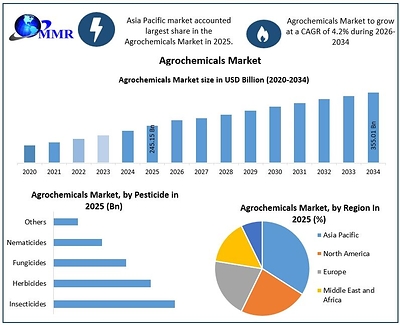
PUNE, India, Sept. 28, 2026 /PRNewswire/ — The Global Agrochemicals Market was valued at USD 245.15 Billion in 2025 and is projected to expand at a 4.2% CAGR from 2026 to 2034, reaching USD 355.01 Billion by 2034, according to a new analysis by Maximize Market Research.
Global Agrochemicals Market
The Global Agrochemicals Market Report 2025 provides a detailed analysis of market trends, crop protection demand, fertilizer use, pesticide consumption, agricultural productivity, regulatory developments, sustainable farming practices, competitive strategies, and market forecasts through 2034. Agrochemicals are becoming central to modern farming as growers look for better ways to protect yields, improve soil health, and manage pests, weeds, and diseases. Their role is expanding beyond traditional crop protection into nutrient management, precision farming, and integrated pest management. Farmers are increasingly using these products alongside digital tools and biological solutions to improve efficiency. This shift is helping reduce unnecessary chemical use while supporting better crop performance. Demand is especially strong across cereals, grains, fruits, vegetables, and other high-value crops. As agriculture becomes more technology-driven, agrochemicals are evolving into a key part of smarter and more sustainable farming systems.
The Global Agrochemicals Market is growing as farmers work to produce more food from limited farmland while managing pest pressure, crop diseases, changing weather conditions, and rising demand for better yields. Cereals & grains remain an important area of agrochemical use, supported by widespread cultivation of rice, wheat, corn, barley, oats, and other staple crops. At the same time, demand for herbicides, fungicides, insecticides, fertilizers, seed-treatment products, and crop nutrition solutions continues to grow across major farming economies. Precision agriculture, digital farm management, integrated pest management, and biological crop protection are also changing how agrochemicals are selected and applied, helping farmers improve efficiency while reducing unnecessary chemical use.
Innovation in the Agrochemicals Market is increasingly being shaped by sustainable agriculture, biological crop protection, precision farming, new active ingredients, advanced formulations, digital tools, and more efficient fertilizer use. Leading companies are investing in new herbicides, fungicides, insecticides, biological solutions, seed technologies, and integrated crop-management systems to address resistant weeds, changing pest patterns, and environmental concerns. Recent developments from BASF, Syngenta, Bayer, UPL, and Corteva-linked partnerships show how strongly the industry is moving toward smarter crop protection and more targeted farm solutions. Growing investment in R&D, sustainable formulations, precision application, and farmer-focused technologies is expected to create new opportunities across the Global Agrochemicals Market through 2034.
Get Full PDF Sample Copy of Report: (Including Full TOC, List of Tables & Figures, Chart) @ https://www.maximizemarketresearch.com/request-sample/105150/
The Global Agrochemicals Market is entering a more intelligent phase of growth as crop protection, fertilizer efficiency, precision agriculture, biological solutions, and sustainable farming come together to reshape modern food production. As farmers face greater pressure to protect yields, manage resistant pests, and use resources more carefully, innovation in agrochemicals is becoming central to the future of agriculture: Maximize Market Research reveals the key forces shaping the market through 2034.
Global Agrochemicals Market Size & Forecast
|
Parameter |
Value |
|
Market Size (Base Year 2025) |
USD 245.15 Billion |
|
Forecast Market Size (2034) |
USD 355.01 Billion |
|
CAGR (2026-2034) |
4.2 % |
|
Base Year |
2025 |
|
Forecast Period |
2026-2034 |
|
Historical Period |
2020-2025 |
Global Agrochemicals Market Trends & Insights
- Biological crop protection and bioinputs are gaining ground as farmers look for ways to reduce dependence on conventional chemicals while maintaining yields. FAO highlighted bioinputs in 2026 as a strategic response to fertilizer-market volatility and climate pressure, supporting wider interest in biopesticides, biofertilizers, biological crop protection, and integrated pest management.
- Precision agriculture is changing how agrochemicals are applied, with farmers increasingly using sensors, digital platforms, data analytics, targeted spraying, and variable-rate nutrient management. This shift is helping improve fertilizer efficiency, pesticide use, crop protection performance, and farm productivity while reducing unnecessary input use.
- Crop protection innovation is accelerating as pest, weed, and disease pressure remains high. Bayer noted in 2026 that plant diseases and pests can destroy up to 40% of global crops each year, reinforcing demand for advanced herbicides, insecticides, fungicides, seed technologies, and new crop protection modes of action.
- Fertilizer and agrochemical supply chains are becoming more sensitive to energy, trade, and geopolitical risks. FAO’s 2026 Food Outlook highlighted continued links between energy and fertilizer markets, while global agriculture remains exposed to weather disruptions, trade uncertainty, and broader economic shocks. This is increasing attention on supply security, pricing, local production, and more efficient fertilizer use.
- Asia Pacific remains a key growth region for the Global Agrochemicals Market, supported by large farming economies, strong cereal and grain production, rising fertilizer demand, and continued need for crop protection. Expanding use of herbicides, fungicides, insecticides, biological crop protection, and precision farming technologies is helping farmers improve productivity while managing pests, diseases, and changing growing conditions more efficiently.
Rising Need to Protect Crop Yields Drives Agrochemicals Market Growth
The growing need to protect crops from weeds, pests, diseases, and climate-related stress is a major driver of the Global Agrochemicals Market. Nearly 40% of global crop yields are lost to pests and diseases each year, while weeds alone can reduce yields by close to 34%. This keeps demand strong for herbicides, insecticides, fungicides, fertilizers, seed-treatment products, and other crop protection solutions. Rising food demand, limited farmland, cereal and grain production, and pressure to improve farm productivity are further supporting agrochemical use across major agricultural regions.
Strict Regulations and Changing Farm Economics Restrain Market Growth
The Agrochemicals Market also faces pressure from tighter pesticide regulations, environmental rules, product restrictions, and changing farm support policies. Europe, in particular, continues to apply stricter standards to crop protection products and agricultural chemicals, making regulatory approval more complex and expensive. Farmers can also become more cautious about adopting premium agrochemical products when subsidies decline or input costs rise. These factors can slow product launches, increase compliance costs, and put pressure on agrochemical companies that rely heavily on major herbicides, pesticides, and traditional crop protection chemicals.
Precision Farming, Biologicals, and Sustainable Agriculture Create New Opportunities
Precision agriculture, integrated pest management, biological crop protection, and digital farming are opening new opportunities across the Global Agrochemicals Market. Farmers are increasingly using sensors, data analytics, targeted spraying, and digital tools to apply fertilizers and pesticides more accurately. At the same time, demand is rising for biopesticides, biofertilizers, pheromone-based products, and other biological solutions that support sustainable agriculture. The growing role of machine learning and AI in agricultural R&D are helping companies shorten development timelines and improve product testing, while creating new possibilities for smarter crop protection and nutrient management.
Resistance, Climate Pressure, and Supply Challenges Create Market Risks
The Agrochemicals Market continues to face challenges from herbicide-resistant weeds, changing pest patterns, climate stress, fertilizer price volatility, and supply-chain disruptions. Continuous cropping and limited crop rotation can weaken soil health and increase resistance problems, forcing farmers to use more advanced crop protection strategies. At the same time, manufacturers must balance product performance, environmental impact, farmer affordability, and regulatory compliance. Companies that can combine effective herbicides, insecticides, fungicides, fertilizers, biological solutions, precision agriculture, and sustainable formulations are better placed to respond to these changing market conditions.
Get Insightful Data on Regions, Market Segments, Customer Landscape, and Top Companies (Charts, Tables, Figures and More) https://www.maximizemarketresearch.com/request-sample/105150/
Global Agrochemicals Market Segmentation
The Global Agrochemicals Market is segmented by Pesticide Type, Fertilizer Type, Crop Type, and Region. Rising demand for crop protection, higher agricultural productivity, improved fertilizer efficiency, pest and disease management, and sustainable farming practices is supporting market development across these segments.
|
Segmentation |
Sub-Segments |
|
By Pesticide Type |
Insecticides; Herbicides; Fungicides; Nematicides; Others |
|
By Fertilizer Type |
Nitrogenous Fertilizer; Phosphatic Fertilizer; Potassic Fertilizer |
|
By Crop Type |
Cereal & Grains; Oilseeds & Pulses; Fruits & Vegetables; Others |
|
By Region |
North America; Europe; Asia Pacific; Middle East & Africa; South America |
Asia Pacific Leads the Global Agrochemicals Market as Large Farming Economies, Crop Protection Demand, and Fertilizer Use Support Regional Growth
Asia Pacific is the leading region in the Global Agrochemicals Market, supported by the scale of agriculture across China, India, Japan, South Korea, Australia, and Southeast Asia. Demand remains strong for herbicides, insecticides, fungicides, fertilizers, seed-treatment products, and biological crop protection as farmers work to improve yields and protect crops from weeds, pests, and diseases. The region’s large cereal and grain production base, growing use of precision farming, and continued investment in fertilizer efficiency and sustainable agriculture are keeping Asia Pacific at the center of global agrochemical demand.
North America remains an important Agrochemicals Market, supported by highly commercialized farming, large-scale cultivation of corn, soybean, wheat, fruits, and vegetables, and strong use of crop protection chemicals and fertilizers. Farmers in the United States, Canada, and Mexico are increasingly combining agrochemicals with precision agriculture, targeted spraying, digital farm management, and more efficient nutrient application. This shift is helping the region improve crop productivity while reducing waste and making better use of fertilizers, herbicides, insecticides, and fungicides.
Europe continues to play a major role in the Global Agrochemicals Market, although the region is moving steadily toward safer and more sustainable crop protection. Germany, France, Italy, Spain, the United Kingdom, and other European countries continue to use herbicides, fungicides, insecticides, fertilizers, and specialty crop inputs across a wide range of crops. At the same time, stricter environmental rules, pesticide reduction goals, integrated pest management, and more efficient fertilizer use are encouraging manufacturers to develop lower-impact formulations, biological alternatives, and precision application technologies.
South America is a key growth region for agrochemicals, supported by large-scale production of soybean, corn, sugarcane, coffee, fruits, and other export-oriented crops. Brazil and Argentina remain major agricultural markets where farmers depend on herbicides, fungicides, insecticides, fertilizers, and crop nutrition products to manage pest pressure and maintain high yields. Expanding export agriculture, resistant weeds, crop diseases, and the need for reliable crop protection are encouraging wider use of advanced agrochemical products and integrated pest-management practices.
The Middle East & Africa Agrochemicals Market is gradually developing as governments and agricultural businesses invest in food security, irrigation, farm productivity, and local crop production. South Africa, GCC countries, Egypt, Nigeria, and other markets are seeing growing demand for fertilizers, pesticides, specialty nutrients, and crop protection solutions. As farming systems modernize, greater use of agricultural inputs, biological solutions, and more efficient fertilizer application is creating long-term opportunities across the region.
Leading Companies Strengthen the Global Agrochemicals Market
Bayer AG, Syngenta Group, BASF SE, Corteva Agriscience, FMC Corporation, UPL Limited, ADAMA Ltd., Nufarm Limited, Nutrien Ltd., Yara International, OCP Group, Sumitomo Chemical, and other major players are strengthening their position in the Global Agrochemicals Market through new product development, crop protection innovation, biological solutions, advanced formulations, precision agriculture, and stronger regional distribution. Companies are investing in herbicides, insecticides, fungicides, fertilizers, seed treatments, biological crop protection, digital farming tools, and integrated crop-management systems to address changing farmer needs and rising pressure from pests, resistant weeds, climate stress, and regulatory requirements.
Global Agrochemicals Market Competitive Landscape
The Global Agrochemicals Market is shaped by product performance, regulatory approvals, crop protection efficiency, fertilizer innovation, biological solutions, pricing, distribution strength, R&D capability, and the ability to serve farmers across different crops and regions. Competition is moving beyond conventional pesticides and fertilizers as companies invest in new active ingredients, sustainable agrochemicals, biopesticides, biofertilizers, precision agriculture, digital farming, and integrated pest management. Recent activity from BASF, Syngenta, Bayer, UPL, and Corteva-linked partnerships shows how strongly the market is shifting toward smarter, more targeted, and more sustainable agricultural solutions. Companies that can combine effective crop protection, reliable supply, digital tools, biological products, competitive pricing, and strong farmer support are continuing to strengthen their position in the global market.
Immediate Delivery Available | Buy this Research Report (Insights, Charts, Tables, Figures and More) https://www.maximizemarketresearch.com/checkout/105150/
Agrochemicals Market Key Players:
- OCP GROUP (United States)
- Nutrien Ltd. (United States)
- FMC Corporation (United States)
- DuPont de Nemours, Inc. (United States)
- Marrone Bio Innovations, Inc. (United States)
- Corteva Agriscience(United States)
- Bayer AG (Germany)
- Syngenta Group (Switzerland)
- BASF SE (Germany)
- Yara International ASA (Norway)
- ADAMA Ltd. (Israel)
- Israel Chemicals Ltd. (Israel)
- UPL Limited(Mumbai, India)
- Sumitomo Chemical Co., Ltd. (Japan)
- Nufarm Limited (Australia)
- Mitsubishi Chemical Corporation (Japan)
- ChemChina (Syngenta Group) (Beijing, China)
- Ihara Chemical Industry Co., Ltd. (Japan)
Frequently Ask Questions:
1. What makes the Asia Pacific a Lucrative Market for Agrochemicals Market?
Ans. Textiles, sugar, animal husbandry, and vegetable oil manufacture are among the emerging agro-based businesses that are driving this growth.
2. What are the top players operating in the Agrochemicals Market?
Ans. ADAMA LTD, BAYER, BASF SE, SYNGENTA AG, UPL, COMPASS MINERALS, EUROCHEM GROUP, and OCP GROUP.
3. What is the key driving factor for the growth of the Agrochemicals Market?
Ans. The requirement to maintain agricultural integrity is expected to play a significant role in increasing sales in the global agrochemicals market.
4. What is the market size of the Global Agrochemicals Market by 2034?
Ans. The Agrochemicals Market size was valued at USD 245.15 Bn. In 2034 the total Agrochemicals Market revenue is growing by 4.2 % from 2026 to 2034, reaching USD 355.01 Bn.
5] What was the Global Agrochemicals Market size in 2025?
Ans: The Global Agrochemicals Market size was USD 245.15 Billion in 2025.
Access Full Summary: https://www.maximizemarketresearch.com/market-report/global-agrochemicals-market/105150/
Analyst Perspective
Analysts see the Global Agrochemicals Market moving through a period of steady change, shaped by the simple but urgent need to grow more food, protect every harvest, and use farm inputs more wisely. Herbicides, insecticides, fungicides, and fertilizers remain at the heart of modern agriculture, helping farmers hold back weeds, pests, and disease while protecting crop yields. Yet the road ahead is not without pressure, as stricter regulations, resistant pests, shifting farm economics, and volatile input costs continue to test manufacturers. Through 2034, the strongest opportunities are expected to come from precision agriculture, biological crop protection, sustainable formulations, digital farming, integrated pest management, and smarter fertilizer use.
Related Reports:
Pesticides Market by Pesticides Type, Crop Type, Product Type, and Region – Global Forecast to 2034
Fungicides Market by Type, Crop Type, Application, and Region – Global Forecast to 2034
Nitrogenous Fertilizers Market by Type, Crop, Form, and Region – Global Forecast to 2034
Insecticides Market by Crop Type, Type, Formulation, Form, and Region – Global Forecast to 2034
Biorational Pesticides Market by Type, Source, Application, Crop Type, Formulation, and Region – Global Forecast to 2034
Seed Treatment Market by Treatment Type, Crop Type, Function, Application Technique, and Region – Global Forecast to 2034
Crop Protection Chemicals Market by Type, Source, Form, Mode of Application, Crop Type, and Region – Global Forecast to 2034
About Maximize Market Research – Global Agrochemicals Market
Maximize Market Research is a global market research and business consulting firm providing data-driven insights across the Chemical & Material, agriculture, crop protection, fertilizers, pesticides, biologicals, precision farming, and related sectors. Its Global Agrochemicals Market research covers herbicides, insecticides, fungicides, nematicides, nitrogenous fertilizers, phosphatic fertilizers, potassic fertilizers, cereal & grains, oilseeds & pulses, fruits & vegetables, sustainable farming, integrated pest management, regional demand, regulatory developments, competitive strategies, and emerging agricultural technologies, helping businesses understand market changes and identify new growth opportunities through 2034.
MMR Statistics is a part of Maximize Market Research, developed to provide quick access to market size, industry data, forecasts, trends, and statistical insights across a wide range of sectors. It presents research data in multiple formats, making it easier for businesses, analysts, and decision-makers to use market intelligence for presentations, strategy, benchmarking, and business planning.
Calcium Aluminate Market – Global Industry Analysis and Forecast (2026-2034) – Stellar Market Research
Stellar Market Research is a strategic partner of Maximize Market Research, providing global and region-wise market research reports across multiple industries. Its research focuses on market trends, competitive developments, regional opportunities, industry dynamics, and growth outlooks, complementing Maximize Market Research with broader market coverage and region-specific business intelligence.
Contact:
Lumawant Godage
MAXIMIZE MARKET RESEARCH PVT. LTD.
+91 96073 65656
Email: sales@maximizemarketresearch.com
Visit Our Web Site: https://www.maximizemarketresearch.com/

 View original content to download multimedia:https://www.prnewswire.com/news-releases/global-agrochemicals-market-to-reach-usd-355-01-bn-by-2034-as-fertilizer-demand-advanced-crop-protection-and-sustainable-farming-gain-momentum-says-maximize-market-research-302891630.html
SOURCE Maximize Market Research Pvt. Ltd.
