
SHANGHAI, Oct. 22, 2026 /PRNewswire/ — Neurointerventional robots have long remained at the stage of “only being able to assist with angiography.” Through close medical-engineering collaboration with Professor Jianmin Liu’s team at Shanghai Changhai Hospital, Shenzhen Institute of Advanced Biomedical Robot Co., Ltd. independently developed a new-generation vascular interventional surgical robot technology and product platform, PANVIS STAR®, for neurointerventional diagnostic and therapeutic procedures, and conducted preclinical animal studies across various neurointerventional indications.To our knowledge, this system is the first to achieve simultaneous coaxial control of three catheters and one guidewire, and is capable of operating rapid-exchange devices (balloons and balloon-expandable stents). In a porcine model, full-process validation was completed for five major categories of procedures: cerebral angiography and establishment of therapeutic access, aneurysm coil embolization, flow diverter (FD) deployment, vertebral artery stenting, and carotid artery stenting. All procedures were successful, with no device-related complications or vascular injury. The entire process, from guidewire and catheter superselective navigation to implant deployment, was performed by the robot, while manual operations were limited to catheter sheath insertion, device exchange, and loading in a radiation-free environment. The study was published in the Journal of Robotic Surgery.
01 | Background: The Leap from “Angiography-Capable” to “Treatment-Capable”
Robotic assistance has entered routine endovascular practice, but its clinical role has largely remained at the level of diagnostic angiography. Extending robotic assistance to therapeutic neurointervention is considerably more demanding: a single procedure may require the coordinated manipulation of a guiding catheter, an intermediate catheter, a microcatheter and a microguidewire, together with rapid-exchange devices such as balloons and stents, delivered over a working length that extends from the femoral or radial access site to the intracranial target. Covering this entire chain of devices with one platform, rather than assisting only selected steps, is therefore the central requirement for a treatment-capable robotic system, and it defines three engineering priorities: compatibility with standard neurointerventional devices, unrestricted delivery travel, and precise coordination of several devices simultaneously.
02 | Mechanical Innovation of PANVIS STAR®: Master-slave collaboration, multi-device manipulation
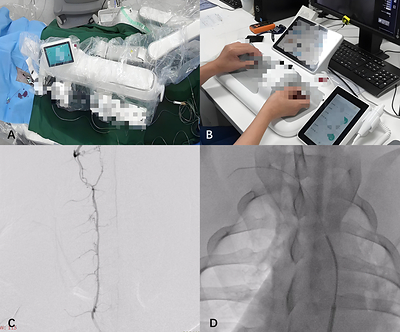
PANVIS STAR® features a master-slave collaborative architecture. The master control console can be deployed outside the interventional suite, allowing the operator to work free of radiation exposure. The bedside execution unit adapts to the interventional environment, supports multi-dimensional adjustment, and accommodates both radial and femoral access.
The system supports multi-device collaborative operation, combining coaxial and rapid-exchange techniques to meet the device-coordination requirements of complex interventional procedures. Precise linear delivery and rotation control enable stable and accurate manipulation of guidewires and catheters, supporting submillimeter-level precision during superselective navigation and device deployment.
For sterile protection, a disposable sterile barrier and a rapid-turnover design isolate the robot body from the surgical field, balancing safety, turnover efficiency and clinical usability.
The master controller adopts the “Catheter On Finger” (PANVIS COF®) design. Its control levers are arranged horizontally, reproducing the spatial layout of guidewires and catheters on the procedure table, so that the mapping between the operator’s hand and the device is one-to-one and consistent with established manual habits and muscle memory. Multiple delivery modes are provided, enabling forward and backward motion, rotation, and combined movements such as simultaneous advancement and rotation.
|
Action |
Manual Procedure |
PANVIS STAR® control |
|
Device advancement |
Operator pushes forward with the left hand |
Push the control lever horizontally to the left |
|
Device retraction |
Operator pulls backward with the right hand |
Pull the control lever horizontally to the right |
|
Device rotation |
Twist the device longitudinally |
Rotate the control lever longitudinally |
03 | Establishment of Animal Models
The work has been reported in accordance with the ARRIVE guidelines (Animals in Research: Reporting In Vivo Experiments), and all animal procedures were approved by the Institutional Animal Ethics Committee. The team created lateral wall aneurysms on the common carotid arteries of 3 anesthetized surviving pigs by end-to-side anastomosis using an autologous venous pouch (bilateral aneurysms in 2 animals). A total of five surgically created aneurysms were allocated to coiling alone (n = 2), FD implantation (n = 2), and coiling + FD (n = 1). In addition, one right vertebral artery (V1 segment) and one right common carotid artery were utilized for vertebral artery balloon-expandable stent angioplasty and CAS, respectively. Since the objective was to validate technical feasibility rather than to simulate pathological stenosis, no artificial stenosis models were created.
Success was defined as completion of the planned procedure without device malfunction and without vascular damage, with vascular damage assessed by comparison of pre- and postprocedural angiography.
04 | Results: All Procedures Successful, With All Fluoroscopic Steps Completed by the Robot
In the porcine model, all planned procedures were performed successfully, with no relevant technical complications or vascular damage. The mean procedural time of each procedure was as follows:
|
Procedure |
Core steps completed by the robot |
Steps still performed manually |
Mean procedural time |
|
Diagnostic cerebral angiography |
Navigation of the 5F catheter and 0.035-inch guidewire from the femoral sheath to the target vessel, completing bilateral carotid and vertebral angiography |
Insertion of the arterial sheath |
26 min |
|
Navigation of the guiding catheter |
Placement of the 8F guiding catheter with the assistance of a 125 cm MPA catheter and a 0.035-inch guidewire, enabling synchronized coaxial control of the two catheters |
— |
6 min |
|
Aneurysm coiling |
Superselective navigation of the microcatheter into the aneurysm sac withmicroguidewire assistance, withdrawal of the microguidewire, and delivery and deployment of coils (3 coils) through the microcatheter |
Loading of the coils into the microcatheter through the protective sheath |
24 min |
|
FD deployment |
Navigation of the microcatheter to the parent artery and complete deployment of the FD, including slow microcatheter retraction and fine-tuning of the delivery wire tension |
Loading of the FD into the microcatheter through the protective sheath |
16 min |
|
Vertebral artery (VA) stenting |
Navigation of the balloon-expandable stent to the vertebral artery, with the robot maintaining distal wire stabilization during balloon inflation, deflation and retrieval |
Loading of the stent and microguidewire into the Y valve; balloon inflation |
13 min |
|
Carotid artery stenting (CAS) |
Delivery and retrieval of the cerebral protection device (Spider FX), navigation of the balloon and stent, and deployment of the self-expanding stent |
Loading of devices into the Y valve; balloon inflation |
43 min |
Notably, all manual steps were limited to device exchange and loading in a radiation-free environment; from catheter navigation to device deployment, nearly all steps were performed robotically, and robotic assistance did not increase the complexity of the procedure.
05 | Discussion: Device Delivery Performance and Multi-Device Collaborative Operation
PANVIS STAR® addresses the above bottlenecks through four breakthrough designs: a task-oriented modular four-drive unit, a travel-unlimited linear delivery mechanism, a high-precision rotation mechanism, and a COF master control system. COF replaces the previously counterintuitive vertical-axis joystick paradigm with a horizontal-axis joystick, achieving 1:1 motion mapping between manual manipulation and robotic control: device advancement corresponds to “left-hand push forward / joystick push up / control lever horizontal left shift,” retraction corresponds to “right-hand pull back / joystick pull down / control lever horizontal right shift,” and rotation corresponds to “vertical twisting / horizontal joystick ring rotation / control lever vertical rotation.” Operators no longer need to perform mental remapping of directions and can focus their attention on the surgical strategy itself.
To our knowledge, PANVIS STAR® is the first robotic platform capable of simultaneous coaxial control of three catheters and one guidewire, coupled with rapid-exchange functionality. It is fully compatible with all kinds of standard neurointerventional devices (various catheters, microcatheters, balloons, stents, etc.), providing the mechanical basis for multi-device collaborative procedures.
06 | Limitations and Future Directions
- This study is a pilot experiment performed in only 3 porcine models, without a manual control group, and the sample size is limited;
- Larger-scale trials with clinical and follow-up endpoints are still needed for validation.
- The capability for simultaneous multi-device management opens up robotic applications for emergency scenarios such as mechanical thrombectomy in acute ischemic stroke and emergency embolization for aneurysmal subarachnoid hemorrhage; the team has completed a validation study of long-distance remote robot-assisted emergency surgery.
07 | Conclusion
This preclinical pilot study demonstrates that the PANVIS STAR® multi-device robotic system is technically feasible for cerebral angiography, guiding catheter navigation, aneurysm embolization, flow diverter (FD) deployment, vertebral artery stenting and CAS, without increasing procedural complexity. As a small-sample preclinical study, larger-scale clinical studies with a manual control group are still needed to further validate its efficacy and safety; the system’s multi-device collaborative capability also provides a technical foundation for scenarios such as remote emergency thrombectomy and embolization of ruptured aneurysms.
Original Article Information
Zhang Y, Ma H, Li J, et al. Feasibility of a novel multi-device robotic system for multiple neurointerventional procedures: pre-clinical validation in porcine models. J Robotic Surg. 2026;20:863. doi:10.1007/s11701-026-03736-4
Co-first authors: Yongxin Zhang, Hongyu Ma and Jiayan Li; Corresponding authors: Jianmin Liu, Shuxiang Guo and Pengfei Yang.
This research was supported by the National Natural Science Foundation of China (Grant No. 82401536).
Contact:
abrobo
marketing@abrobo.com
+860755-82772975
 View original content to download multimedia:https://www.prnewswire.com/apac/news-releases/chinas-voice-preclinical-animal-study-domestic-neurointerventional-robotic-system-panvis-star-completes-validation-of-five-major-neurointerventional-procedures-302916523.html
SOURCE Shenzhen Institute of Advanced Biomedical Robot Co., Ltd. (abrobo)
