

Infrastructure investment removes legacy constraints and establishes a platform for consistent delivery
PERTH, Australia, Oct. 21, 2026 /CNW/ — Westgold Resources Limited (ASX: WGX) (TSX: WGX) (Westgold or the Company) has removed legacy mine infrastructure constraints to establish a platform that supports a sustained 2Mtpa mining rate at the Beta Hunt underground mine at Kambalda.
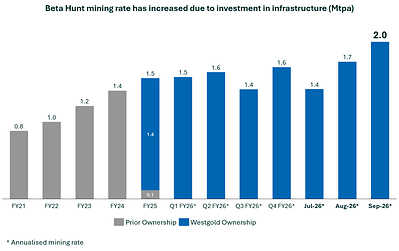
Beta Hunt achieved a record annualised mining rate of 2Mtpa in September 2026, before the interim primary ventilation system was commissioned (ahead of schedule at month-end). With the supporting infrastructure now in place, the Company is targeting sustained performance at this rate from Q2 FY27.
Westgold acquired Beta Hunt in August 2024 as a high-quality orebody constrained by ageing infrastructure and limited drilling. Before acquisition, the operation had not sustained mining rates above 1.4Mtpa.
Westgold has systematically removed these constraints through investment in drilling, ventilation, dewatering, water supply, power distribution, mine services, underground infrastructure and mine design optimisation, establishing Beta Hunt now as a modern underground operation.
Highlights
|
Mine infrastructure upgrades completed enabling a material lift in mining rates – 2Mtpa annualised mining rate achieved in September. |
|
|
Beta Hunt targeting a consistent 2Mtpa mining rate from Q2 FY27 |
Westgold Managing Director and CEO Wayne Bramwell commented:
“Prior to acquisition Westgold identified that Beta Hunt needed investment in two areas to operationally derisk and enable growth of this large underground mine. Our team has now removed key operational constraints by replacing or upgrading key mine infrastructure and completed over 85km of diamond drilling in the last 2 years, adding +1.1Moz of reserve at approximately $27/oz.
Completion of these engineering upgrades now establishes Beta Hunt as a modern mining operation capable of sustaining 2Mtpa mining rates from Q2 FY27 onwards.”
Infrastructure works support 2Mtpa mining rates
Since the acquisition of Beta Hunt in August 2024, Westgold has focused on removing mine infrastructure constraints that historically limited Beta Hunt average mine output at ~1.4Mtpa. The execution of these upgrades is completed and will enable reliable performance at 2Mtpa from Q2 FY27, demonstrated by September performance hitting an annualised 2Mtpa run rate (see Figure 1).
Key infrastructure works over the last 2 years include:
|
Workstream |
Scope delivered |
Status / timing |
Investment |
|
Primary ventilation – 801 fan station and associated mine development. |
2 × 1.7MW fan station (designed for ~500m³/s) installed; fan reliability has prevented full commissioning with vendor working to rectify |
Recovery plan with vendor underway and alternative options review (not required for 2 years). |
$10.3M |
|
Interim 801 primary ventilation |
Interim primary vent solution delivered in 3 months from FID; produces sufficient ventilation capacity for ~2 years at mining rates of 2Mtpa. |
Commissioned in late September 2026. |
$7.4M |
|
Primary dewatering |
Replacement of the 801 rising main (only discharge path from the mine); upgraded primary pumping station. |
Rising main and pump station commissioned mid FY26. |
$2.5M |
|
Secondary dewatering |
Replacement of pumping network, inclusive of 12 pumps, pipework upgrades and optimising the long-term capacity of the network. |
Completed in October 2026 |
$3.7M |
|
Water supply and services |
Water supply and reticulation network upgraded to ensure supply meets demand from UG equipment. |
Completed late FY26 |
$1.5M |
|
Surface Power Upgrade |
Upgrade the surface power supply, installing new overhead power lines to meet long-term power requirements. |
Completed mid FY25 |
$5.0M |
|
Underground Power upgrade |
Upgrade underground power supply architecture, adding redundant power supply cables to the underground operation. |
Completed late FY26 |
$2.9M |
|
Total |
$33.3M |
Mine ventilation capacity established
Beta Hunt is a large underground mine. The mineralised system is approximately 7km in strike with circa 4km of this strike developed with ventilation historically one of the key constraints limiting mining rates.
Post acquisition in 2024 and as part of the planned infrastructure upgrade program, Westgold installed a new primary fan station at the 801 level during FY26 (LOM system). These new fans were to support the planned increase in mining rates and represented a critical component of the Company’s strategy to expand the operation.
While the LOM system initially supported a step-change in productivity, bearing and coupling failures limited their output. This ventilation constraint impacted the ramp up of Beta Hunt and diverted production to the upper parts of the mine. As advised by the fan vendor, additional bracing was installed to the LOM system in Q4 FY26 and, whilst demonstrating the capability for the system to support a 2Mtpa profile, it did not improve the reliability of the ventilation system.
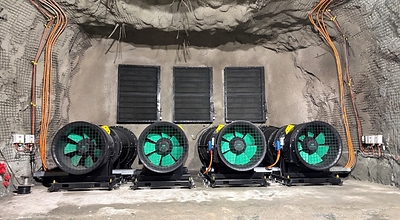
To mitigate the equipment reliability issue and support the ramp up in production rates, Westgold announced it would procure and install an independent interim ventilation solution with the planned commissioning during Q2 FY27. Westgold completed this project ahead of schedule at the end of September 2026, installing and commissioning the interim system in the 801-level return airway (see Figure 2).
This installation provides airflow required to deliver the targeted 2Mtpa mining rate and enables Westgold to achieve mining targets while the LOM fans are repaired, recommissioned or replaced.
Westgold is working with the vendor responsible for the initial turn-key fan installation to rectify the reliability issues. In parallel the Company is progressing alternative LOM options with alternative vendors.
The installed interim system will be repurposed at other Westgold operations once the LOM system is re-established.
Reliable underground water supply established
At acquisition, Beta Hunt’s aged underground water supply system lacked the capacity and reliability required to support an expanded underground mining operation. Water storage and distribution capacity was constrained, while poor water quality contributed to ongoing equipment downtime and reduced operating efficiency.
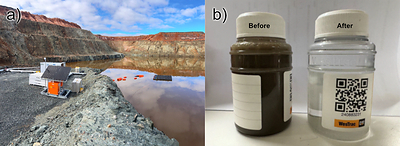
Westgold secured access to a nearby open pit as a water source and settling facility, then installed a twin-bore pontoon pumping system to return water underground (see Figure 3a). The upgrades improved the availability, quality and reliability of water supplied to long-hole drill rigs, jumbos and other underground equipment, supporting higher productivity and utilisation (see Figure 3b).
Additionally underground water supply reticulation services were inadequate to support the operation due to age related degradation. Westgold has replaced significant amounts of the reticulation network including piping and pressure management systems allowed suitable distribution of the cleaner water.
Dewatering capacity upgraded
Westgold has upgraded the dewatering network throughout Beta Hunt.
At acquisition the age and complexity of the infrastructure lacked the capacity and reliability to manage operational water discharge and natural groundwater inflows. The installed legacy network was designed for approximately 12L/s, compared with peak requirements closer to 50L/s.
This contributed to continual sump overflows and flooding in parts of the mine and road washouts, restricting access and reducing mine productivity.
Westgold has progressively rebuilt the dewatering system from the active mining areas through to the surface discharge point. The secondary dewatering network was expanded through the installation of 12 WTX3 pumps and the replacement of the existing 110mm poly-pipe network with 125mm pipe. In total, approximately 7.6km of pipework was installed over six months to improve the collection and transfer of water from underground work areas.
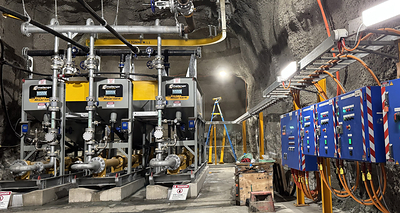
The primary dewatering system was also upgraded, through the installation of three WT107 pumps at the 801 level (see Figure 4) and replacement of the rising main and associated pipework. Together, these upgrades provide an upgraded pumping system for transferring water from the underground workings to the surface settling facility, reducing the risk of localised flooding and supporting more consistent access to active mining areas.
Power supply reinforced
On acquisition Westgold identified that the existing high-voltage power supply from surface to the underground mine lacked the capacity and reliability required to support the planned production ramp-up. Voltage-drop issues also presented a risk of production disruption.
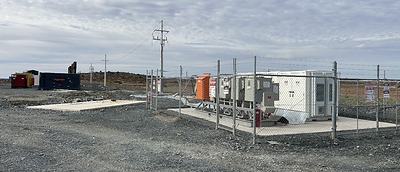
To address these constraints, Westgold installed new overhead power lines and additional power banks and upgraded the ring main units (see Figure 5).
In early 2025, Westgold identified the B6 Feeder cable had degraded to the point where it was at risk of failure. The cable supplied over 50% of the mine with power along with providing power to the primary ventilation system. Additionally, the B6 Feeder cable was run through a ventilation rise which was exposed to salt and environmental degradation.
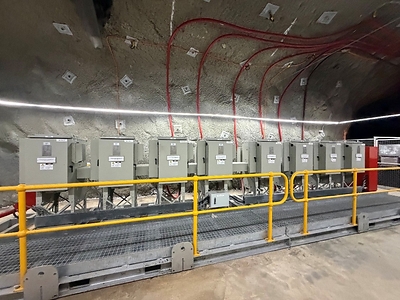
A new service hole was drilled in early 2026 to provide a secondary power feed for the underground mine with a new Ring Main Unit installed (see Figure 6). This project was completed in May 2026, delivering redundancy and reliable underground power to the operation.
Mine design optimisations
Following the acquisition of Beta Hunt, Westgold’s technical and operational teams undertook a comprehensive review of the mine plan, supported by accelerated resource definition drilling and development ahead of production. This work addressed historic underinvestment in mine development and improved geological confidence, creating the planning flexibility required to optimise mining sequences, development layouts and production schedules.
To enhance mine productivity, the technical team has used this improved information base to redesign key elements of the mine plan, targeting lower capital intensity, reduced operating costs and greater flexibility in mining rates and scheduling.
Key optimisations include:
- Consolidation of the decline network from four declines to three – reducing capital development requirements and creating longer, more efficient development drives.
- The revised layout simplifies access, improves development efficiency and supports more productive mining sequences.
- Introduction of multi-lift open stoping – to reduce capital and operating costs and increase the proportion of free-bogging ore.
- Stope designs and extraction sequences have been optimised to improve productivity and reduce material handling requirements.
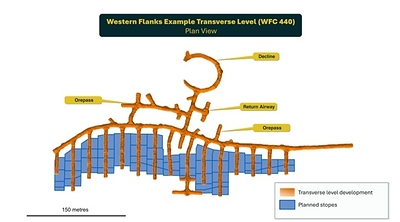
- Adoption of transverse mining methods in Western Flanks – following detailed technical assessment of the orebody geometry and mining alternatives (see Figure 7).
- Although requiring higher upfront capital, the approach is expected to lower unit operating costs.
- The revised design also provides greater flexibility to adjust mining rates and optimise production schedules.
- Installation of improved UG mobile equipment servicing and refuelling areas (to be completed in Q2 FY27)
- While not required to deliver the targeted mining rates, this will lower operating costs and improve reliability of the operation.
- Grade and production optimisation – through improved geological definition and mine scheduling.
- The optimised plan better reflects the natural grade distribution of the orebody, enabling tonnage to be flexed while targeting lower mining costs and improved value delivery.
The technical work completed has reduced execution risk of the Beta Hunt mine plan by improving geological confidence, advancing development ahead of production and providing greater flexibility in mining sequences and schedules.
Westgold intends to maintain this focus through continued investment in resource definition drilling, drilling platforms and capital development, supporting improved production readiness and more consistent delivery against the mine plan.
Looking ahead
With ventilation and other infrastructure no longer constraining the Beta Hunt mine plan, Westgold’s focus shifts to consistent delivery of 2Mtpa run rates.
The recently commissioned interim primary ventilation installation provides sufficient airflow to support planned mining activities over the next two years and is expected to sustain mining rates of 2Mtpa from Q2 FY27. The existing LOM fans will be repaired, recommissioned or replaced with no impact on delivery of the plan.
Together with the extensive dewatering, power and other infrastructure upgrades completed over the past 2 years, Beta Hunt is now positioned to exceed installed mill capacity at Higginsville. Building a mined ore stockpile over FY27 ensures that Higginsville’s capacity of +1.6Mtpa can be fully utilised and establishes a buffer start-up stockpile to support a larger processing hub in the Southern Goldfields.
Looking further ahead, Westgold continues to advance the Fletcher Zone as the next key driver of mine expansion at Beta Hunt.
- Drilling continues with seven rigs underground at Beta Hunt.
Six rigs are operating on reserve conversion (Fletcher) and one rig on resource extension (Mason).
- Integrated Southern Goldfields expansion studies are expected to be completed in Q3 FY27.
The studies are assessing the optimal mining, hoisting, ore-handling and processing pathway for an expanded operation incorporating Fletcher and will define the timing, infrastructure and processing solution required to support higher mining rates.
The processing DFS is evaluating two development scenarios:
i) development of a new 4Mtpa processing hub closer to Beta Hunt – producing ~250kozpa standalone and increasing total Southern Goldfields milling capacity (inclusive of the existing 1.6Mtpa Higginsville facility) to approximately 5.6Mtpa, and providing Westgold with optionality over the future of the Higginsville infrastructure.
ii) expansion of the Higginsville processing hub to treat 4Mtpa of Beta Hunt ore – supporting production of approximately 250koz per annum.1
|
This announcement is authorised for release to the ASX by the Board. Investor and media relations enquiries |
|
|
Investor Relations Kasun Liyanaarachchi Group Manager Investor Relations & Communications |
Media Annette Ellis Manager Communications & Corporate Affairs +61 458 200 039 |
Forward Looking Statements
These materials prepared by Westgold Resources Limited include forward looking statements. Often, but not always, forward looking statements can generally be identified by the use of forward looking words such as “may”, “will”, “expect”, “intend”, “believe”, “forecast”, “predict”, “plan”, “estimate”, “anticipate”, “continue”, and “guidance”, or other similar words and may include, without limitation, statements regarding plans, strategies and objectives of management, anticipated production or construction commencement dates and expected costs or production outputs.
Forward looking statements inherently involve known and unknown risks, uncertainties and other factors that may cause the Company’s actual results, performance and achievements to differ materially from any future results, performance or achievements. Relevant factors may include, but are not limited to, changes in commodity prices, foreign exchange fluctuations and general economic conditions, increased costs and demand for production inputs, the speculative nature of exploration and project development, including the risks of obtaining necessary licenses and permits and diminishing quantities or grades of reserves, political and social risks, changes to the regulatory framework within which the Company operates or may in the future operate, environmental conditions including extreme weather conditions, recruitment and retention of personnel, industrial relations issues and litigation.
Forward looking statements are based on the Company and its management’s good faith assumptions relating to the financial, market, regulatory and other relevant environments that will exist and affect the Company’s business and operations in the future. The Company does not give any assurance that the assumptions on which forward looking statements are based will prove to be correct, or that the Company’s business or operations will not be affected in any material manner by these or other factors not foreseen or foreseeable by the Company or management or beyond the Company’s control.
Although the Company attempts and has attempted to identify factors that would cause actual actions, events or results to differ materially from those disclosed in forward looking statements, there may be other factors that could cause actual results, performance, achievements or events not to be as anticipated, estimated or intended, and many events are beyond the reasonable control of the Company.
In addition, the Company’s actual results could differ materially from those anticipated in these forward-looking statements as a result of the factors outlined in the “Risk Factors” section of the Company’s continuous disclosure filings available on SEDAR+ or the ASX, including, in the Company’s current annual report, half year report or most recent management discussion and analysis.
Accordingly, readers are cautioned not to place undue reliance on forward looking statements. Forward looking statements in these materials speak only at the date of issue. Subject to any continuing obligations under applicable law or any relevant stock exchange listing rules, in providing this information the Company does not undertake any obligation to publicly update or revise any of the forward-looking statements or to advise of any change in events, conditions or circumstances.
__________________________________________
|
1 Refer ASX announcement “FY27 Guidance and Three-Year Outlook” dated 9 September 2026 for further information. |
SOURCE Westgold Resources Limited
